
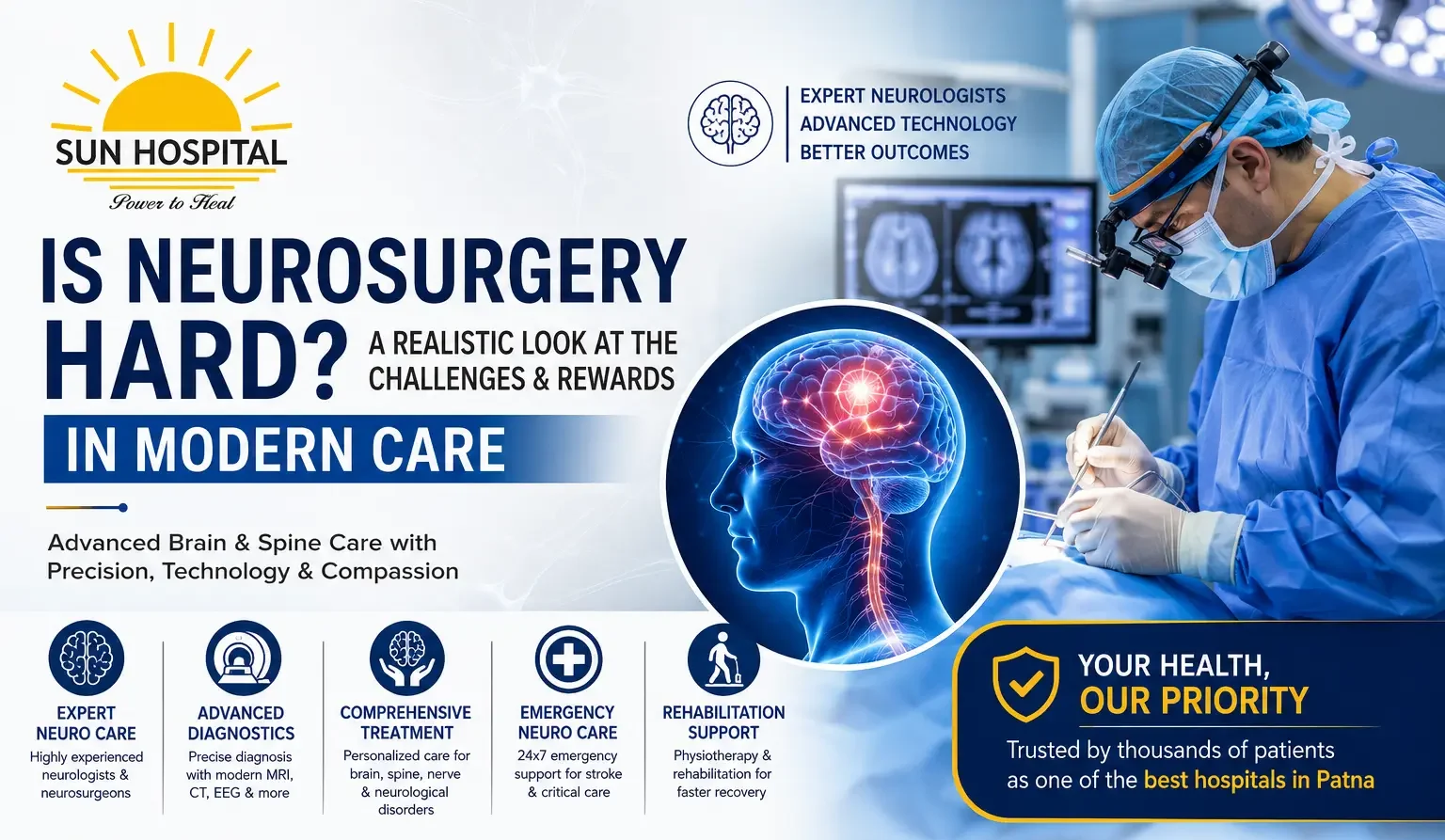
If you’ve ever sat in a doctor’s waiting room clutching an MRI report, wondering what happens next, you already know how frightening a brain or spine diagnosis can feel. It’s one of the first questions almost every patient asks: is neurosurgery hard, and can I trust someone to operate on something as delicate as my brain or spinal cord? It’s a fair question, and honestly, one worth answering properly rather than brushing aside with reassurances alone. This is exactly why so many families searching for the best neurology services in Patna want to understand the process before they commit to a treatment plan.
As someone who has spent years around operating theatres, patient consultations, and post-surgical recovery wards, I can tell you that neurosurgery is genuinely one of the toughest fields in medicine. But “hard” doesn’t mean “hopeless.” In fact, with the right expertise and the right facility, outcomes today are better than they’ve ever been.
Why Neurosurgery Is Genuinely Difficult
Let’s not sugarcoat it. Operating on the brain, spine, or nerves is not comparable to most other surgeries, and here’s why.
The Margin for Error Is Incredibly Small
The brain runs everything, movement, speech, memory, emotion, breathing. A millimetre of miscalculation near the wrong bundle of nerves can change a person’s life permanently. That’s why neurosurgeons rely heavily on brain mapping, high-resolution imaging, and microscopic instruments that let them work with a level of accuracy that simply wasn’t possible a generation ago.
Every Case Demands a Fresh Decision
No two brains, spines, or tumours behave identically. Before recommending any procedure, a specialist has to weigh the patient’s history, scan reports, current symptoms, general health, and the risks against the expected benefit. This isn’t a checklist exercise, it’s a judgment call built on years of pattern recognition and training.
Becoming a Neurosurgeon Takes Years, Not Months
By the time a neurosurgeon performs an independent operation, they’ve usually spent well over a decade studying anatomy, assisting in surgeries, and handling complications under supervision. That long apprenticeship is exactly what gives patients confidence when they walk into surgery.
How Modern Neurology Care Has Changed the Game
Here’s the encouraging part. Neurological medicine has evolved faster in the last fifteen years than in the previous fifty, and patients are the ones benefiting.
Diagnosis Has Become Far More Precise
Gone are the days of guesswork. MRI scans, CT imaging, EEG monitoring, and nerve conduction studies now allow doctors to pinpoint problems early, often before symptoms turn severe. Catching a condition sooner almost always means a simpler, less invasive treatment path.
Minimally Invasive Techniques Are Reducing Recovery Time
Traditional brain and spine surgery once meant large incisions, long hospital stays, and months of recovery. Today, many procedures can be done through much smaller openings.
which typically means:
- Less post-operative pain
- Shorter hospital stays
- Faster return to daily activities
- Lower risk of complications
This shift is a big reason why families who once feared surgery now approach it with far more confidence.
Conditions That Bring Patients Through Our Doors
Brain Tumours Need Individualized Planning
Not every tumour needs immediate surgery. Depending on its size, location, and behaviour, a specialist might recommend surgery, radiation, medication, or a combination of these. This is where consulting someone who genuinely understands neurological nuance, not a one-size-fits-all approach, makes all the difference.
Spine and Nerve Compression Cause Everyday Suffering
Numbness in the hands, shooting pain down the leg, or sudden weakness in the fingers often traces back to a compressed nerve or a slipped disc. These conditions are treatable, and most patients recover well once the root cause is identified correctly.
Stroke Care Is a Race Against Time
According to the World Health Organization, stroke continues to be a leading cause of long term disability worldwide. Every minute matters, which is why emergency response speed, rehabilitation support, and follow-up prevention planning are just as important as the initial treatment.
What to Look for When Choosing Neurological Care
If you or a loved one is facing a neurological concern, the hospital you choose matters as much as the diagnosis itself.
A few things worth checking before you decide:
- Are the specialists experienced in the exact condition you’re dealing with?
- Does the facility have advanced imaging and diagnostic equipment on site?
- Is there a proper emergency and critical care setup for sudden complications?
- Are treatment plans personalized rather than generic?
Patients who take the time to compare these factors before choosing among the best neurology services in Patna usually feel far more settled going into treatment, because they know exactly who is treating them and why.
Recovery Is a Partnership, Not a One Time Event
Surgery is only half the story. What happens afterward, physiotherapy, regular follow-ups, and lifestyle adjustments, often determines how well a patient truly heals. Doctors can perform a flawless operation, but recovery still depends heavily on the patient’s discipline and the support system around them. This is a point I always stress to families: healing is a shared responsibility between the medical team and the person walking through it.
Is Neurosurgery Worth the Risk?
For anyone living with chronic pain, seizures, or weakness that keeps getting worse, surgery can genuinely turn things around. That said, let’s be honest, it’s tough on the surgeon and nerve-wracking for the patient. There’s no getting around that. What has changed is the safety net around it. Accurate diagnosis, an experienced team, and a facility ready for both planned procedures and sudden emergencies have shifted the odds meaningfully in the patient’s favour. This is the same thinking behind how Sun Hospital has shaped its neurology and neurosurgery practice, precision in the operating room paired with a genuinely patient-first attitude at every step, not just during surgery itself. As one of the best hospitals in Patna, the focus stays on getting patients the right technology, the right specialists, and a treatment plan built around their specific case rather than a generic template. The World Health Organization has pointed out that early diagnosis and timely access to good healthcare make a real difference in how neurological patients recover, and that’s a principle worth taking seriously rather than treating as a footnote. It’s this same commitment to steady, detail-focused care that Sun Hospital tries to bring to every patient who walks through its doors.
Final Thoughts
Neurosurgery will always be one of medicine’s most demanding disciplines, and there’s no point pretending otherwise. But “difficult” doesn’t mean “out of reach.” Between advanced diagnostics, minimally invasive techniques, and specialists who train for years before touching a scalpel, patients today have far better odds than earlier generations ever did. If you’re searching for the best hospital in Patna to guide you through a neurological concern, the right first step is simply asking questions, getting a proper evaluation, and choosing a team you genuinely trust. That’s really what sets apart the best neurology services in Patna, not just the equipment in the room, but the people reading your reports and sitting across from you when it matters most.
Frequently Asked Questions
1. Is neurosurgery considered one of the hardest medical specialties?
Yes. It demands extreme precision, extensive training, and complex decision-making because it involves the brain, spine, and nervous system.
2. When should I see a neurologist?
If you notice frequent headaches, seizures, unexplained numbness, memory lapses, or balance problems, it’s worth getting a neurological evaluation without delay.
3. What conditions do neurosurgeons commonly treat?
Brain tumours, spinal disc problems, nerve compression, head injuries, and stroke-related complications are among the most common cases.
4. How long does recovery after neurosurgery usually take?
It varies widely, some patients recover in a few weeks, while more complex cases may need several months of rehabilitation.
5. Is minimally invasive neurosurgery available for all conditions?
Not always. Suitability depends on the type, size, and location of the problem, which is why a detailed diagnostic evaluation is essential first.